


Public Notice: Water Assistance & Shower Assiatnce:
Water Assistance:
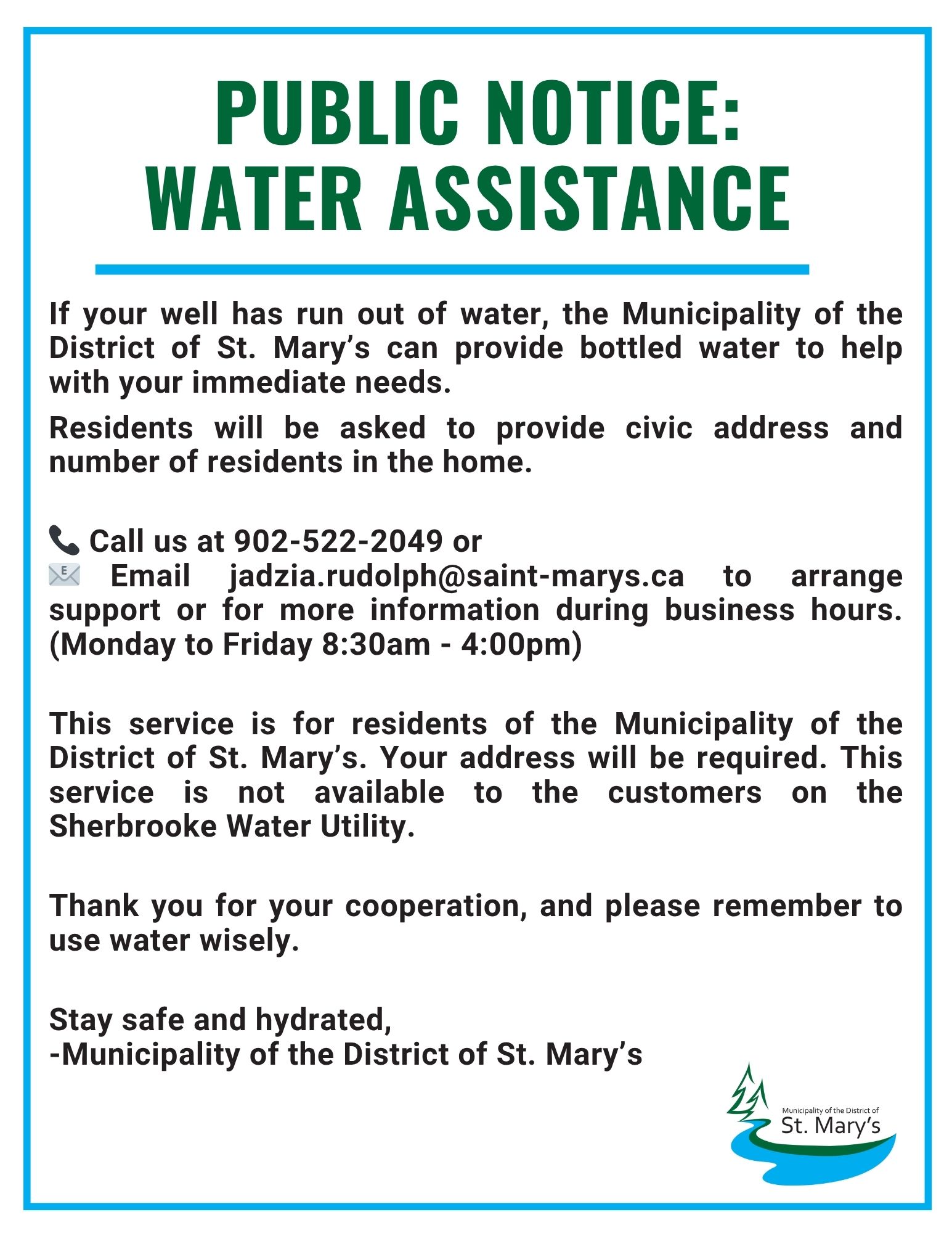
If your well has run out of water, the Municipality of the District of St. Mary’s can provide bottled water to help with your immediate needs.
Residents will be asked to provide civic address and number of residents in the home.
📞 Call us at 902-522-2049 or
📧Email This email address is being protected from spambots. You need JavaScript enabled to view it. to arrange support or for more information during business hours. (Monday to Friday 8:30am - 4:00pm)
This service is for residents of the Municipality of the District of St. Mary’s. Your address will be required. This service is not available to the customers on the Sherbrooke Water Utility.
Thank you for your cooperation, and please remember to use water wisely.
Stay safe and hydrated,
-Municipality of the District of St. Mary’s
Shower Assistance:
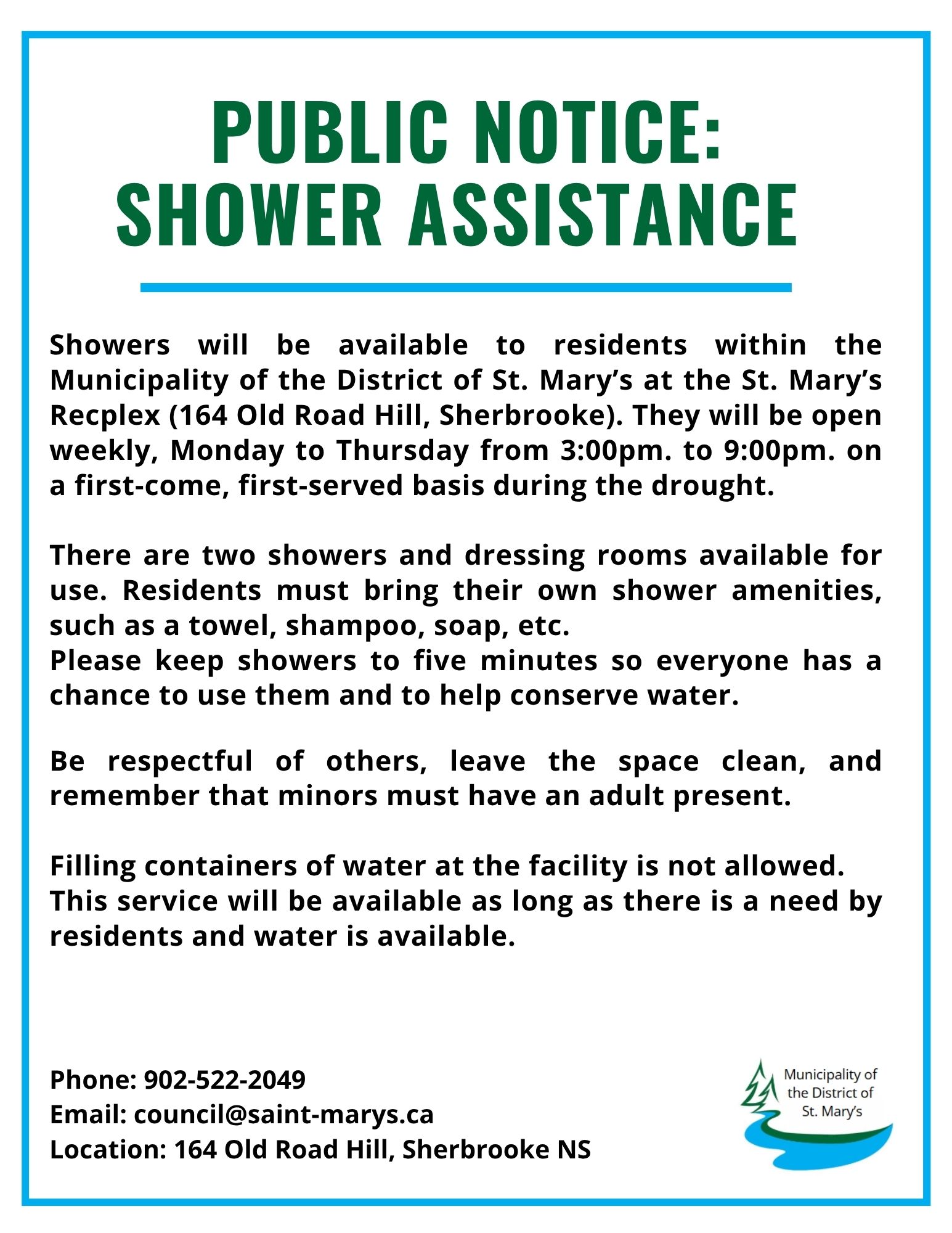
Showers will be available to residents within the Municipality of the District of St. Mary’s at the St. Mary’s Recplex (164 Old Road Hill, Sherbrooke). They will be open weekly, Monday to Thursday from 3:00pm. to 9:00pm. on a first-come, first-served basis during the drought.
There are two showers and dressing rooms available for use. Residents must bring their own shower amenities, such as a towel, shampoo, soap, etc.
Please keep showers to five minutes so everyone has a chance to use them and to help conserve water.
Be respectful of others, leave the space clean, and remember that minors must have an adult present.
Filling containers of water at the facility is not allowed.
This service will be available as long as there is a need by residents and water is available.
Public Notice: Voluntary Water Conservation Order
Effective October 28, 2025, at 4:00pm
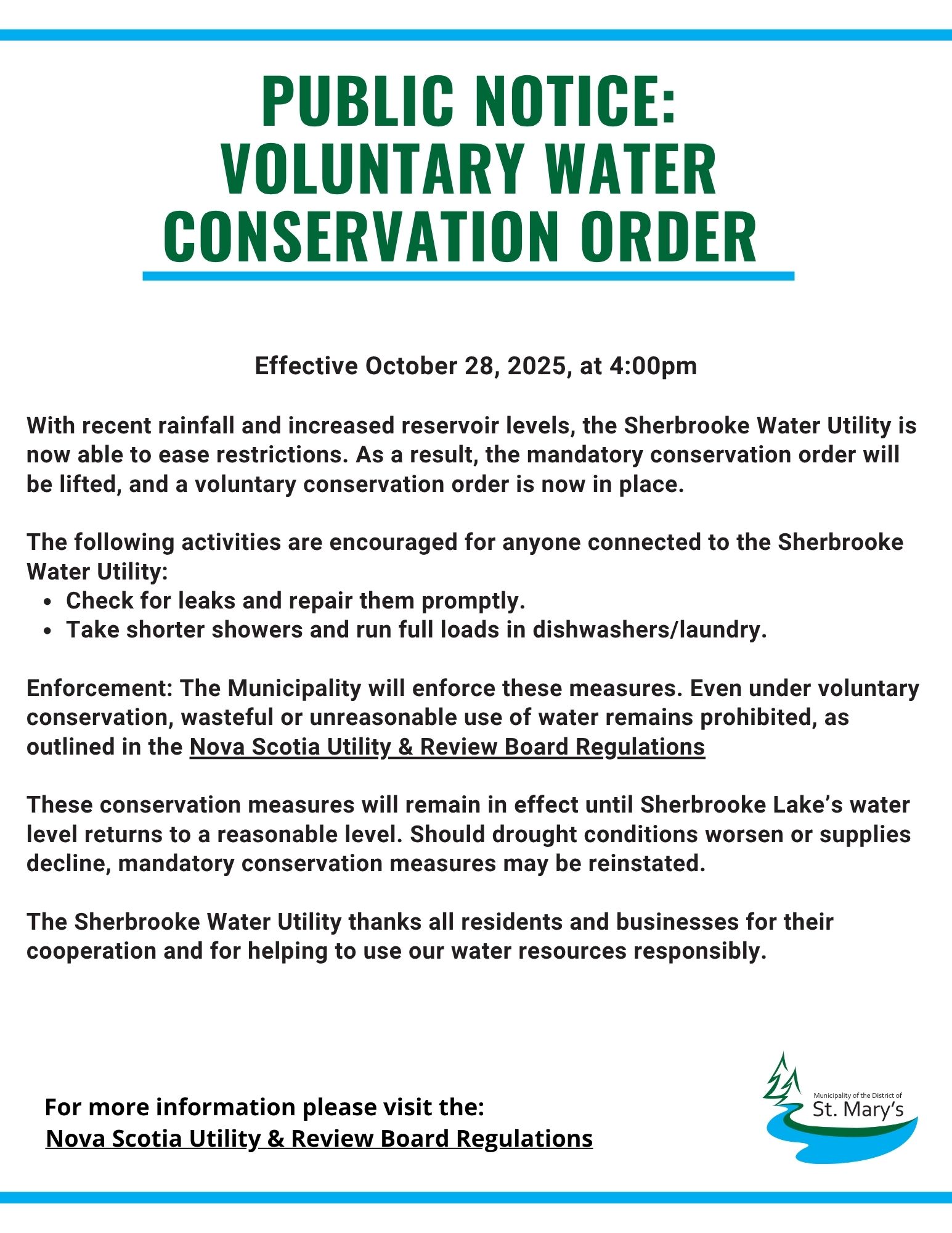
With recent rainfall and increased reservoir levels, the Sherbrooke Water Utility is now able to ease restrictions. As a result, the mandatory conservation order will be lifted, and a voluntary conservation order is now in place.
The following activities are encouraged for anyone connected to the Sherbrooke Water Utility:
- Check for leaks and repair them promptly.
- Take shorter showers and run full loads in dishwashers/laundry.
Enforcement: The Municipality will enforce these measures. Even under voluntary
conservation, wasteful or unreasonable use of water remains prohibited, as
outlined in the Nova Scotia Utility & Review Board Regulations
These conservation measures will remain in effect until Sherbrooke Lake’s water level returns to a reasonable level. Should drought conditions worsen or supplies decline, mandatory conservation measures may be reinstated.
The Sherbrooke Water Utility thanks all residents and businesses for their cooperation and for helping to use our water resources responsibly.
For more information please visit the:
Nova Scotia Utility & Review Board Regulations
St. Mary's Recplex Delayed Opening
The opening of the St. Mary’s Recplex, planned for November 13, will be postponed due to the ongoing drought conditions. Although we have had some rain this week, operating the rink requires a significant amount of water continuously. All available options are being pursued to prepare the rink for the upcoming season while remaining mindful of the community’s need to conserve water.
We understand this delay may be disappointing and appreciate your patience as we work through these challenges. Updates will be provided on the municipality’s website and Facebook page, every Friday afternoon until further notice.
We encourage everyone to continue conserving water wherever possible to help support our community resources during this dry period.
Thank you for your understanding and continued support.
For immediate release: Announcing Warden James Fuller as the Eastern Counties Regional Library Board Chair
Eastern Counties Regional Library (ECRL) is pleased to announce that Warden James Fuller, member from the Municipality of the District of Saint Mary’s, was elected as the new Library Board Chair at the October 16, 2025, meeting. Warden Fuller brings to the role decades of public service and experience.
“I was raised in libraries, as my mother was a librarian, stated Fuller. “I believe very much that a library is the soul and heartbeat of each of our communities. Bringing the world of imagination to growing children and adults alike. I am looking forward to serving in this role.”
“Finally, I would be remiss not to recognize and thank Clair Rankin, who helped guide ECRL as Chair for the past two years and who has served on the Board for almost 19 years. He will remain a valuable resource and our institutional memory for a long time to come.” said Warden Fuller.
Please follow ECRL on social media for service updates: facebook.com/ECRLibrary and instagram.com/ecrl_ns
For more information, please contact:
Laura Emery, CEO
This email address is being protected from spambots. You need JavaScript enabled to view it.
902-631-4403
Public Notice: Planned Power Outage
Attention residents of Melrose, Waternish, Stillwater, Sherbrooke, Goldenville, Jordanville, Indian Harbour Lake, Port Hilford, Holland Harbour, Harpellville, Bickerton West, Port Bickerton, Fishermans Harbour, and neighbouring communities.
This will impact approximately 900 customers in the communities of Melrose, Waternish, Stillwater, Sherbrooke, Goldenville, Jordanville, Indian Harbour Lake, Port Hilford, Holland Harbour, Harpellville, Bickerton West, Port Bickerton, Fishermans Harbour, and neighbouring communities.
Customers have been notified via call outs. You can find more information on this planned outage on NSP website: Planned Outages| Nova Scotia Power
Notice: Water Utility Maintenance
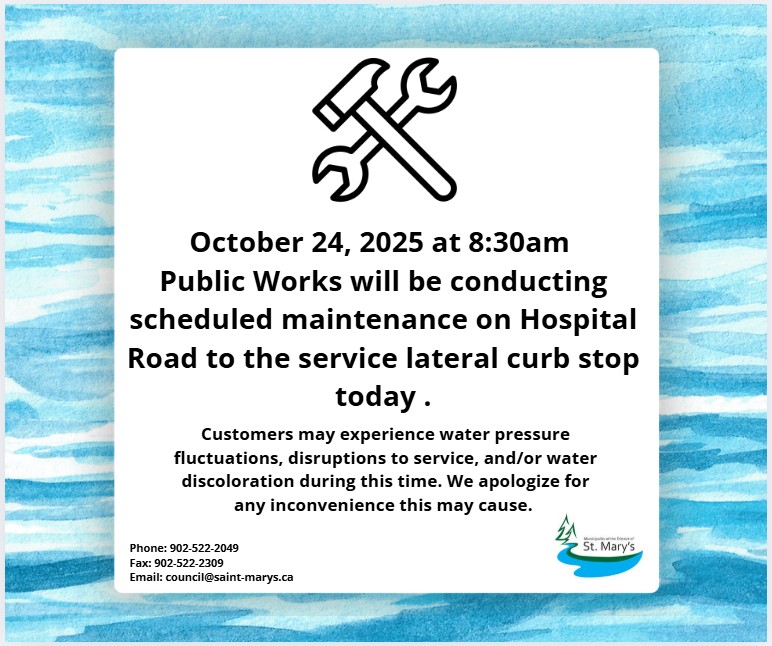
Please be advised that on October 24, 2025 beginning at 8:30am Public Works staff will be conducting scheduled maintenance and repairs to the water system on Hospital Road Extension
Customers/Users may experience water pressure fluctuations, disruptions to service and discoloration during this time.
We apologize for any inconvenience this may cause.